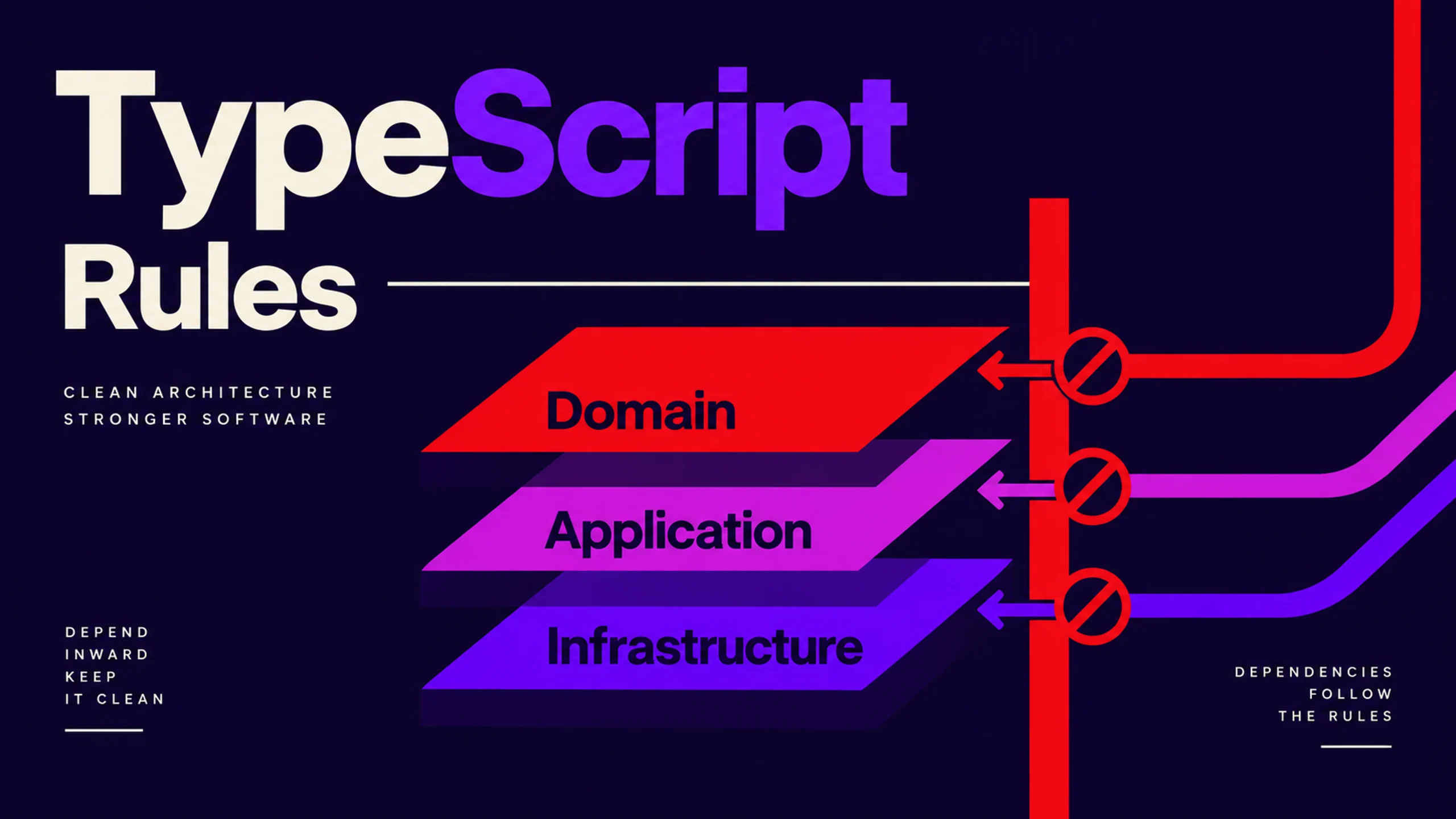
You wrote the docs. You did the PR reviews. You explained it in the onboarding. And yet, six months later, a bunch of controllers are directly importing a repository, and nobody noticed.
The Real Problem With Architecture
Clean Architecture, Hexagonal, Layered: whatever you're following, the rules only exist in two places: your head, and a README nobody reads.
The moment a deadline hits, someone takes a shortcut. A controller calls a repository directly. A domain model imports a NestJS decorator. An infrastructure class leaks into your application layer. It's not malicious. It's invisible. Nobody gets a red light. The tests still pass. The app still ships.
Six months later, you have a codebase that looks structured but behaves like a mess.
The fix isn't more PR comments or awareness. It's making the rules prevail.
Architecture Tests: Rules That Enforce Themselves
Architecture tests are automated tests that don't test your logic. They test your structure. They answer questions like: Does anything in the domain layer import from infrastructure? Is any controller talking directly to a repository? Do all use cases follow the naming convention we agreed on?
If the answer is ever yes, the build fails. No human needed.
We're going to use ArchUnitTS, published on npm as archunit and inspired by ArchUnit from the Java world.
npm install --save-dev archunitSetting The Rules
Let's say you're running a NestJS app with a layered structure:
src/
  domain/         # Entities, value objects, domain errors
  application/    # Use cases, service interfaces
  infrastructure/ # Repositories, ORM, external services
  http/           # Controllers, DTOs, HTTP concerns
Here are the rules you actually care about enforcing.
Domain must not know about the application or infrastructure layers. The current API does not have an or() combinator, so make each forbidden direction explicit:
import { projectFiles } from 'archunit';

it('domain should not depend on application', async () => {
  const rule = projectFiles()
    .inFolder('src/domain/**')
    .shouldNot()
    .dependOnFiles()
    .inFolder('src/application/**');
  await expect(rule).toPassAsync();
});

it('domain should not depend on infrastructure', async () => {
  const rule = projectFiles()
    .inFolder('src/domain/**')
    .shouldNot()
    .dependOnFiles()
    .inFolder('src/infrastructure/**');
  await expect(rule).toPassAsync();
});
Controllers must not talk directly to repositories:
it('controllers should not import repositories directly', async () => {
  const rule = projectFiles()
    .inFolder('src/http/**')
    .shouldNot()
    .dependOnFiles()
    .inFolder('src/infrastructure/repositories/**');
  await expect(rule).toPassAsync();
});
The application layer must not depend on the infrastructure:
it('application should not depend on infrastructure', async () => {
  const rule = projectFiles()
    .inFolder('src/application/**')
    .shouldNot()
    .dependOnFiles()
    .inFolder('src/infrastructure/**');
  await expect(rule).toPassAsync();
});
Enforcing Naming Conventions
Beyond dependency direction, you can enforce the conventions your team agreed on, the ones currently living in a Notion doc nobody opens.
All use cases must end with UseCase:
it('use cases must follow naming convention', async () => {
  const rule = projectFiles()
    .inFolder('src/application/use-cases/**')
    .should()
    .haveName('*UseCase.ts');
  await expect(rule).toPassAsync();
});
ArchUnitTS's file API checks files, paths, dependencies, and file content. It does not provide the declaration selectors shown in some examples online, such as areInterfaces() or haveNameMatching(). If your team keeps each interface in a dedicated file, enforce the filename instead.
Domain interface files must be prefixed with I:
it('domain interfaces should be prefixed with I', async () => {
  const rule = projectFiles()
    .inFolder('src/domain/interfaces/**')
    .should()
    .haveName(/^I[A-Z].*\.ts$/);
  await expect(rule).toPassAsync();
});
Infrastructure interfaces must be prefixed with I:
it('infrastructure interfaces should be prefixed with I', async () => {
  const rule = projectFiles()
    .inFolder('src/infrastructure/interfaces/**')
    .should()
    .haveName(/^I[A-Z].*\.ts$/);
  await expect(rule).toPassAsync();
});
No circular dependencies:
it('should have no circular dependencies', async () => {
  const rule = projectFiles()
    .inFolder('src/**')
    .should()
    .haveNoCycles();
  await expect(rule).toPassAsync();
});
The Silent Killer Other Libraries Miss
Here's something worth knowing before you pick any architecture testing library: a passing test on zero files is worse than no test at all.
Imagine you write this rule:
const rule = projectFiles()
  .inFolder('src/doamin/**') // typo: should be 'domain'
  .shouldNot()
  .dependOnFiles()
  .inFolder('src/infrastructure/**');
Most libraries will happily match zero files, run zero checks, and report passing. Your architecture rule silently does nothing forever.
ArchUnitTS fails this by default. It reports an empty test, and it won't pass until your pattern actually matches files. You can opt out with allowEmptyTests, but architecture boundaries are usually safer with the default. The behavior is documented in the project's check options. It's a small thing, but it's the kind of false confidence that causes real incidents.
Why This Changes Everything
The usual way of enforcing architecture is expensive: pair programming is good but doesn't scale, PR reviews catch it late and create friction, documentation is ignored under pressure, and verbal agreements are forgotten by next sprint.
Architecture tests flip the model. You write the rule once, and it runs on every single push forever. A developer can't accidentally break your dependency rules without the CI pipeline telling them immediately, with a clear message about exactly which file violated which rule.
This also makes onboarding easier. Instead of explaining "we don't import repositories in controllers here", you just say "try it and see what breaks." The tests become living documentation that actually stays up to date.
The Takeaway
Your architecture is only as strong as your ability to enforce it. Docs rot, memory fades, and deadline pressure is real. Architecture tests turn your structural rules into something that actually has grips, and they run for free on every push for the rest of the project's life.
Add them to your CI pipeline, write them the same day you establish a new rule, and never have another "how did this get in here" moment in a PR review again.