
Web3 products live at the boundary between speed and trust. Draw it badly, and too much else becomes a workaround.
Many teams run into the same issue.
A marketplace puts listing creation on-chain. A game tries to run core gameplay through transactions. A social app stores too much data directly on-chain.
Individually, each decision can seem reasonable. In practice, they can introduce friction, cost, and latency that many users will not tolerate.
The likely result is low engagement, confusing UX, and eventually a painful architectural rethink.
The Decision That Shapes Everything Else
Before any code ships, every Web3 project makes a foundational choice — often without realizing it:
What goes on-chain — and what stays off-chain.
It sounds like infrastructure. It isn’t. This decision determines:
- Whether your product feels fast or frustrating
- Whether your costs remain manageable or explode with scale
- Whether your system is meaningfully trust-minimized — or just marketed that way
- Whether users can verify outcomes — or are forced to trust you
- Whether your product has a reason to exist on a blockchain at all
It’s not just architecture. It’s the core design of trust in your system.
And because trust is the defining feature of Web3, this is the most consequential decision you make. Get it wrong, and everything else becomes a patch on a broken foundation.
Why So Many Teams Get It Wrong
The answer isn’t incompetence. It’s ideology.
Web3 has a set of governing slogans that builders encounter early:
- “Everything should be on-chain”
- “Don’t trust, verify”
- “Minimize trust at all costs”
- “Decentralization is the goal”
These ideas spread because they’re simple, memorable, and directionally correct. The problem is that slogans collapse nuance. They remove tradeoffs. They imply there’s a single correct direction — always more on-chain, always less trust, always more decentralized.
But every architectural decision gives you something and takes something away:
- More replication and decentralization often → less raw performance
- Stronger trust minimization often → higher cost or more complex UX
- More immutability → less operational flexibility
When you ignore these tradeoffs, you don’t eliminate them. You push them somewhere else — usually into user experience, where they become someone else’s problem to diagnose six months later.
The uncomfortable truth is that public blockchains are not designed to be the best tool for most application workloads.
They are designed to create shared, verifiable state without giving one application operator unilateral control. That reduces some trust assumptions; it does not remove trust from consensus, client software, governance, keys, or external data.
Everything else is a compromise.
Base-layer consensus is usually slower and more expensive than a conventional database, while finalized history and deployed contracts are deliberately hard to change. Layer 2 systems and state channels can improve cost and interaction speed, but each introduces its own assumptions and failure modes. Account abstraction can improve interaction design through mechanisms such as sponsorship, batching, and programmable accounts; it does not itself increase consensus throughput or finality speed. Ethereum’s scaling documentation is explicit that different off-chain systems derive security in different ways.
Treat them like conventional general-purpose backends and you will usually pay for the mismatch — not because your idea is bad, but because you’re using the wrong tool for much of the job.
Two Failure Modes, One Root Cause
Teams tend to fall into one of two traps. Both stem from the same misunderstanding.
Trap One: Putting Everything On-Chain
This is the purity model.
The logic feels airtight: “If we want trustless systems, we should minimize reliance on trusted components.” So the team pushes more and more logic on-chain.
Then reality sets in.
Every state-changing interaction becomes a transaction. Someone pays for it, and the system must account for ordering and finality. Even when a sponsor hides the fee or an L2 confirms quickly, those costs and trust assumptions still exist.
What starts as a small inconvenience becomes a structural problem — users hesitate before acting, product loops break, feedback is delayed.
Consider something as simple as updating a setting.
- In Web2: click, instant feedback
- In naive Web3: click → wallet prompt → confirm → wait for inclusion or finality → UI updates
That’s cognitive load, time delay, and financial cost stacked on top of each other. Each can reduce engagement. Together, they can break the product loop.
The deeper issue isn’t UX — it’s that you’re forcing the blockchain to do work it wasn’t designed for.
Public blockchains can be excellent at:
- Finalizing outcomes
- Enforcing rules
- Recording ownership
They are usually a poor fit for:
- Handling frequent updates
- Managing real-time interactions
- Powering user interfaces
Trap Two: Keeping Everything Off-Chain
The second trap optimizes for usability.
The team builds a fast backend, a responsive frontend, a smooth product — and tells themselves they’ll “add decentralization later.”
Early results look good. Users interact instantly, features ship quickly, bugs are easy to fix.
But over time, a question surfaces:
What is the blockchain actually doing here?
If the backend determines outcomes, the database holds the real state, and admins can override behavior — the blockchain is not the source of truth. It’s decoration.
Users can’t verify anything independently. They have to trust your servers, your logic, your integrity.
If the chain adds no independently verifiable guarantee, the product may have no durable reason to use one at all.
The Right Question
Both traps share the same root error. They start by asking:
Where should this logic live?
That’s the wrong question.
The correct question is:
What must be guaranteed — and what can be flexible?
This reframes the entire design process.
Instead of thinking about components, you think about properties:
- What must be immutable?
- What must be publicly verifiable?
- What must be resistant to manipulation?
- What must be fast and responsive?
Each property points naturally to a layer.
On-chain = enforceable commitments under the chain’s trust model. Off-chain = flexibility, with additional trust or proof requirements.
Guarantees are expensive but powerful. Convenience is cheap but requires trust.
Your job isn’t to eliminate one — it’s to allocate each correctly.
Two Worlds With Different Physics
On-chain and off-chain systems operate under fundamentally different constraints.
Conventional off-chain systems can be:
- Fast
- Cheap
- Flexible
- Private, if designed and operated that way
But they often require trust in an operator unless proofs, replication, or another verification model changes that assumption.
Public on-chain systems tend to be:
- Slow
- Expensive
- Difficult to alter after finality
- Public or widely replicated, unless privacy technology changes that property
But they can replace trust in one operator with explicit protocol, governance, key-management, oracle, and bridge assumptions.
You can improve both sides, but you cannot make the tradeoffs disappear.
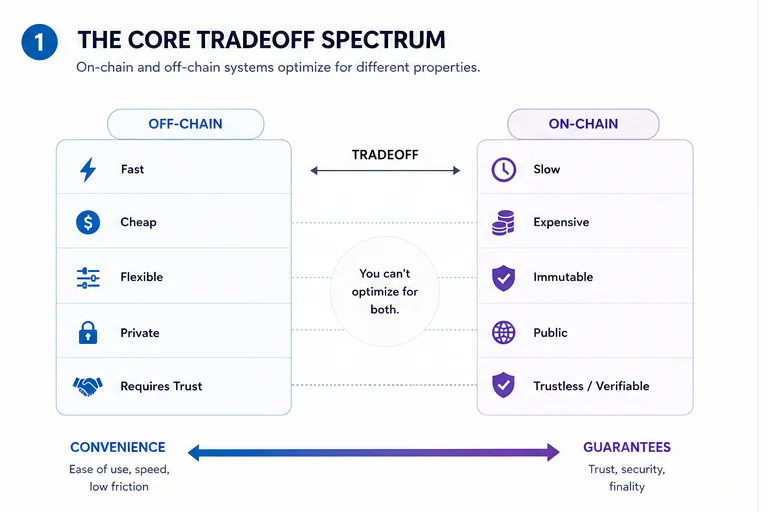
On-chain and off-chain systems optimize for fundamentally different properties. Every product decision lives somewhere along this spectrum.
The art is deciding where each tradeoff is acceptable — and that depends largely on what the user needs to trust you for.
The Boundary Is Your Product
The boundary between on-chain and off-chain is your product.
Not your UI. Not your token. Not your brand.
Your boundary defines:
- What users trust
- What they can verify
- What costs them money
- What feels instant
- What is permanent
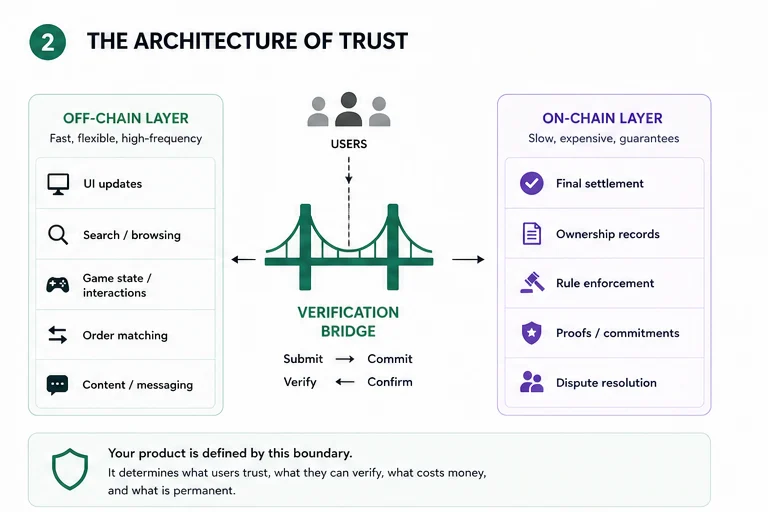
Your product is defined by the boundary between off-chain convenience and on-chain guarantees — and the verification mechanism that connects them.
It’s not a technical detail. It’s the architecture of trust your product is built on.
A Framework That Actually Works
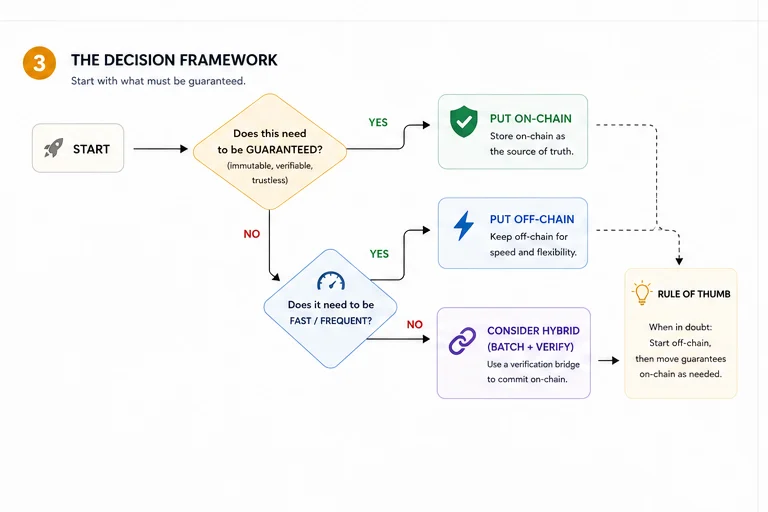
Start with what must be guaranteed — not where code should live. This decision framework prevents the most common Web3 architecture mistakes.
Here’s how to approach the boundary deliberately.
1. Map What Must Be Guaranteed
Ask:
What absolutely must be correct — even if your company disappears tomorrow?
Possible non-negotiables include:
- Asset ownership
- Final balances
- Rule enforcement
- Proof of outcomes
These need an enforceable or independently verifiable mechanism. That may be on-chain execution, a rollup or state channel, a multisignature arrangement, or an off-chain process backed by proofs and dispute rules. The mechanism has to match the threat model.
2. Map What Must Feel Instant
Ask:
What happens frequently and needs very low friction?
- UI updates
- Browsing
- Search
- Order matching
- Game state during play
These usually belong off-chain or on a scaling layer designed for their latency and throughput needs.
3. Design the Verification Mechanism
This is the most overlooked — and most important — part.
How do off-chain actions become inputs that on-chain logic can verify or accept?
A verification mechanism lets off-chain systems make commitments to the chain without putting every action on-chain. Avoid calling every such mechanism a “bridge”: in Web3, that word often means a cross-chain asset or message bridge with a very different risk profile.
Examples:
- A marketplace batches trades and commits final state
- A game anchors match outcomes with cryptographic proofs
- A social app stores content off-chain but publishes content-addressed commitments on-chain
Without proofs, attestations, or a credible dispute process, off-chain processing is usually a trusted service.
With a sound mechanism, you can combine off-chain performance with specific on-chain checks. A hash proves that later bytes match an earlier commitment; by itself, it does not prove that the content was true, available, lawful, or correctly produced. External facts still require an oracle or another trust mechanism, a limitation described in Ethereum’s oracle documentation.
Three Examples That Build on Each Other
To make this concrete, it helps to look at how the same mistake plays out across different categories. Marketplaces, games, and social apps all have different needs — but they tend to fail in similar ways when the boundary is misplaced. Each example isolates a specific pressure — volume, latency, or identity — and shows how it should shape what goes on-chain.
Marketplaces: The Volume Problem
Marketplaces have high interaction volume and high transaction stakes.
The common mistake:
- Putting listing creation, browsing, and filtering on-chain
- Keeping critical settlement logic off-chain
The result: maximum friction, minimal trust reduction.
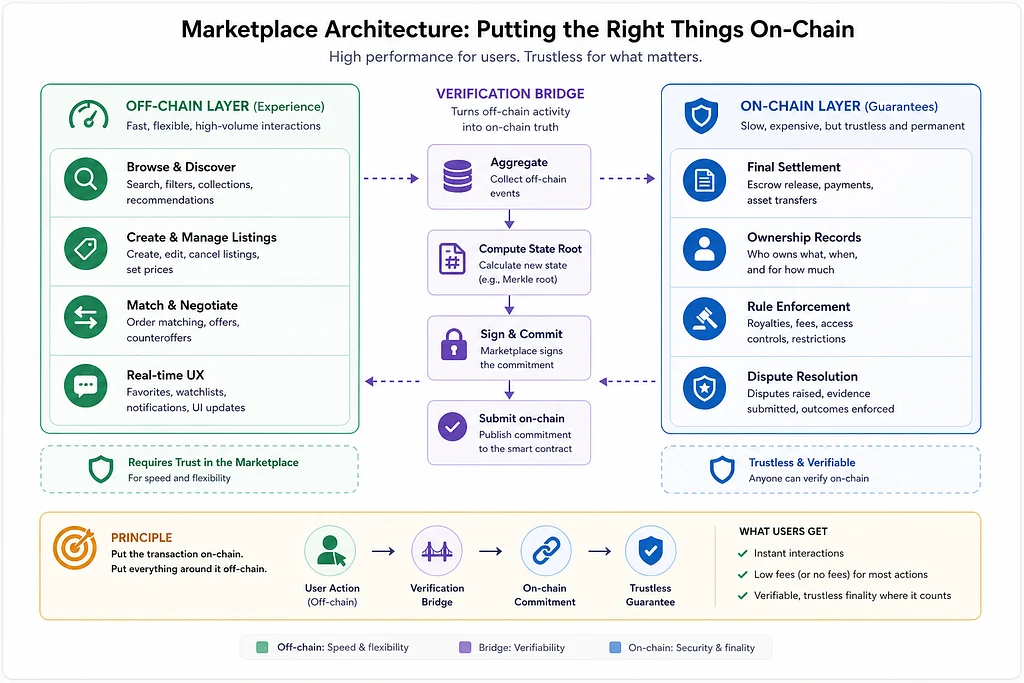
A well-designed marketplace can keep high-frequency actions off-chain while anchoring settlement or commitments on-chain through a verification mechanism.
A better approach:
- Listings, search, discovery → off-chain
- Final settlement → on-chain
- Dispute outcomes → anchored on-chain
Principle: Put settlement and the minimum required commitments on-chain. Keep discovery and presentation off-chain unless the product’s threat model says otherwise.
Games: The Persistence Problem
Games introduce real-time interaction vs long-term value.
Naively putting every gameplay action on a congested base layer can mean:
- Latency and cost that rule out many real-time game designs
Keeping ownership and settlement entirely under one operator can mean:
- Ownership remains subject to that operator’s database and policies
One common boundary:
- Gameplay state → off-chain
- Ownership-affecting outcomes (rewards, trades, tournament results) → on-chain when independent settlement matters
Principle: Keep latency-sensitive state where it can move quickly; commit the durable outcomes users need to verify.
Social Applications: The Identity Problem
Social apps reveal a key distinction:
Content vs identity
- Content → high volume, sometimes high stakes
- Identity and reputation → lower volume, durable, and privacy-sensitive
The right boundary:
- Content → off-chain
- Identity proofs or narrowly scoped reputation claims → on-chain only when public permanence is justified
Principle: Optimize for where trust matters — not where data lives. Do not put raw personal data, social graphs, or permanent reputation scores on a public ledger by default. The European Data Protection Board’s final blockchain guidelines emphasize choosing architectures that meet data-protection requirements rather than treating immutability as an excuse to ignore them.
The Second-Order Effects
The boundary decision shapes everything downstream.
Cost structure. On-chain decisions influence cost per user action. Get the model wrong, and scale can break the economics.
Product velocity. Off-chain components are generally easier to change. On-chain upgrades require explicit governance and can introduce their own security risks.
Trust surface. More off-chain logic usually adds operator, data-availability, or proving assumptions. More on-chain logic reduces some of those assumptions, but adds cost and exposes contract, governance, oracle, and key-management risk.
Recoverability. Finalized on-chain mistakes can be extremely difficult to reverse. Upgradeable contracts and governance can provide recovery paths, but they also mean trusting whoever controls those paths.
This is why starting conservative matters: keep the on-chain surface minimal, but design the intended guarantees and migration path early. “We’ll decentralize later” is not a plan if users cannot verify today’s state or carry it forward.
The Builders Who Get This Right
Strong teams:
- Treat on-chain space as scarce
- Ask “why does this need to be on-chain?” before anything goes there
- Design the verification mechanism early
- Document trust assumptions explicitly
- Revisit the boundary as the system evolves
They understand:
Decentralization is not about maximizing what’s on-chain. It’s about minimizing what needs to be trusted.
What Honesty Actually Requires
Web3 is defined by where trust lives.
When you put something on-chain, you’re saying:
This is enforced or recorded under the chain’s stated assumptions, and independently inspectable to the extent that the data and verification path are available.
When you keep something off-chain, you’re saying:
This introduces additional trust or proof assumptions.
Both are valid.
The mistake is pretending they’re the same.
The teams that build things that matter aren’t the ones who put the most on-chain.
They’re the ones who are precise about what they guarantee, transparent about what they don’t, and disciplined enough to decide that before the architecture is set.