
There is a question that comes up regularly during architecture discussions:
“Why are we building this in .NET?”
It is a fair question.
In 2026, much of the attention belongs to Node.js, Go, Python, and whichever AI framework appeared last week. .NET rarely feels like the fashionable choice.
Yet it remains a platform worth evaluating when a system must handle sensitive data, complex business rules, and years of continuous development.
Not because .NET wins every comparison.
Because it offers a strong combination of performance, type safety, tooling, and platform consistency. It is also an open-source, cross-platform stack whose repositories generally use MIT or Apache 2.0 licenses. The current production baseline, .NET 10, is a Long Term Support release supported by Microsoft through November 14, 2028.
Here is the trade-off, stack by stack. No language wars. Just constraints.
Round 1: .NET vs Node.js - the “how fast can we ship?” fight
Node.js can win the opening round.
For a small team trying to validate a product quickly, its development speed can be difficult to ignore. A team can use JavaScript or TypeScript across the frontend and backend, reducing language switching and sharing selected validation or schema code where that is genuinely useful.
TypeScript 7 has also made part of that workflow significantly faster for supported projects.
Microsoft ported the TypeScript compiler and language tooling to Go, using native code and shared-memory parallelism. In Microsoft's TypeScript 7 release benchmarks, full builds of five large open-source projects were 7.7 to 11.9 times faster than TypeScript 6; its VS Code run fell from 125.7 seconds to 10.6 seconds on the test machine. Those are project-specific measurements, not a promise that every build will improve by the same amount.
The caveat matters: TypeScript 7.0 does not expose a stable programmatic compiler API. The TypeScript team says tools that embed that API, including some Angular, Vue, Svelte, Astro, and MDX workflows, may still need TypeScript 6 for part of their toolchain until a replacement API arrives.
But faster type-checking is not the same as stronger type safety.
TypeScript must remain compatible with JavaScript. Its guarantees can still be weakened through any, type assertions, @ts-ignore, inaccurate third-party declarations, or relaxed compiler settings. Its own handbook explicitly documents deliberately unsound compatibility rules, although TypeScript 7 now enables strict by default.
C# also has escape hatches, including dynamic, reflection, unsafe code, and the null-forgiving operator. Neither language prevents bad domain models or unsafe boundary code. The practical difference is that C# embeds type metadata that the CLR can check at runtime, while TypeScript erases its type annotations when it emits JavaScript.
For an MVP, Node.js may offer the fastest path from idea to customer.
For software handling payments, medical information, complex permissions, or regulated workflows, stronger compiler feedback can become more valuable. It does not establish security or regulatory compliance, but it can make some classes of invalid state harder to represent or easier to catch before deployment.
Choose Node.js when iteration speed is the primary constraint. Choose .NET when correctness and long-term maintainability must be designed in from the beginning.
Round 2: .NET vs Java - the gap is no longer what it used to be
The .NET-versus-Java comparison has changed considerably.
Modern ASP.NET Core is a competitive mainstream platform for high-performance APIs and cloud services.
.NET 10 introduced refinements across JIT compilation, garbage collection, networking, allocation behavior, and common framework abstractions. Microsoft's detailed .NET 10 performance review documents hundreds of micro-optimizations, while warning that results depend on the operation, hardware, operating system, and workload.
Published TechEmpower Framework Benchmark results show that optimized ASP.NET Core implementations can compete at high throughput. They are useful evidence of runtime and framework capability, not an application-level verdict.
Those results matter, but they do not prove that .NET is universally faster than Java.
The benchmark's own test definitions explain the limits. Plaintext exercises request-routing fundamentals; JSON adds object creation and serialization; separate tests exercise database access, updates, templates, and caching. Real systems add authorization, validation, logging, messaging, external calls, and business logic.
As those costs are introduced, raw framework throughput becomes only one part of the result.
It is also misleading to treat Spring Boot as the whole Java ecosystem. Spring MVC, Spring WebFlux, Quarkus, Micronaut, Vert.x and custom Netty applications have different performance profiles.
Java remains extremely competitive in sustained, carefully tuned systems. The JVM offers multiple collectors for different throughput and latency requirements, as the current Java garbage-collection tuning guide makes clear, alongside mature profiling and concurrency tooling. A team with deep JVM expertise can produce exceptional results.
Java can also retain a major organizational advantage inside an established JVM organization: existing libraries, operational knowledge, and integrations may matter more than differences between framework benchmarks.
The important change is not that .NET has defeated Java.
It is that performance is no longer a credible reason to dismiss .NET.
For many APIs, SaaS products, and enterprise services, ASP.NET Core can offer ample performance without making extreme runtime tuning the default development model. Capacity still has to be measured with the application's real database, payloads, middleware, and deployment topology.
Choose Java when existing JVM expertise and ecosystem compatibility dominate the decision. Choose .NET when you want strong performance, modern tooling, and a cohesive cloud application platform.
Round 3: .NET vs Python - model development versus production integration
Python offers an especially mature environment for machine-learning research and experimentation.
For training models, experimenting with architectures, analyzing data, or working inside notebooks, it has a particularly broad set of mature tools. Projects such as PyTorch, JAX, pandas, NumPy, and Hugging Face Transformers all publish first-class Python APIs. That makes Python a natural environment for many ML teams, not the only viable one.
But building an AI product is not the same as creating a model.
An AI product often integrates an existing model into a larger application. It may need to connect that model to business data, expose tools, manage permissions, retrieve documents, track usage, evaluate answers, and operate everything reliably.
.NET has become a credible option for that application layer.
The stable Microsoft Agent Framework packages provide .NET abstractions for agents, tools, sessions, streaming, middleware, OpenTelemetry integration, and graph-based workflows, including human-in-the-loop patterns. The framework is MIT-licensed and supports multiple model providers, but it does not remove the need to design authorization, evaluation, data handling, and failure recovery for a specific product.
EF Core 10 supports the vector type and VECTOR_DISTANCE() in SQL Server 2025 and Azure SQL Database. One important distinction: SQL Server's approximate vector index and VECTOR_SEARCH still require the PREVIEW_FEATURES database setting as of this review. Stable vector storage and distance queries should not be confused with that preview-gated indexing path.
That does not eliminate Python.
Python is often the stronger choice for model training, specialist data pipelines, advanced evaluation, or a required library whose primary interface is in Python.
The real division is simpler:
Python is usually the stronger environment for creating and experimenting with models. .NET is now a credible environment for integrating those models into observable business applications, especially when the surrounding product is already built on .NET.
A system can use both.
Choose Python when the machine-learning work is the product. Choose .NET when AI is one capability inside a larger production platform.
Round 4: .NET vs Go - focused services versus application platforms
Go is extremely effective for focused infrastructure software.
Its language is intentionally small, fast builds were an explicit design goal, and goroutines and channels provide first-class concurrency primitives. Go programs compile ahead of time to native machine code, so pure-Go services can often be deployed as a self-contained executable; cgo and external assets can complicate that picture. These properties are described in the official Go FAQ.
For proxies, gateways, command-line tools, infrastructure agents, rate limiters, and small stateless workers, Go’s simplicity is difficult to beat.
But most commercial platforms are not one isolated microservice.
They include APIs, background processors, scheduled jobs, databases, message consumers, authentication, observability, and increasingly an AI integration layer. The challenge is not only making each service fast. It is keeping the entire system consistent as it grows.
That is where .NET makes a different argument.
Its advantage is not that every .NET service is smaller or faster than its Go equivalent. Its advantage is platform range.
ASP.NET Core, hosted workers, dependency injection, configuration, Entity Framework Core, authentication, authorization, health checks, logging, and tracing follow broadly consistent patterns. Microsoft's ASP.NET Core fundamentals document the shared host, configuration, dependency-injection, middleware, logging, and non-web worker model behind that consistency.
A developer can move between an API, a queue consumer, and a scheduled worker without adopting an entirely different application model.
Go can build all of these things as well. Its minimalism is often a strength. Depending on the libraries and platform already in place, a larger team may need to standardize more of its own application architecture and conventions, or may prefer exactly that degree of control.
Choose Go for small, focused services where footprint and deployment simplicity dominate. Choose .NET when several kinds of backend workloads must evolve under one consistent engineering model.
So who should choose what?
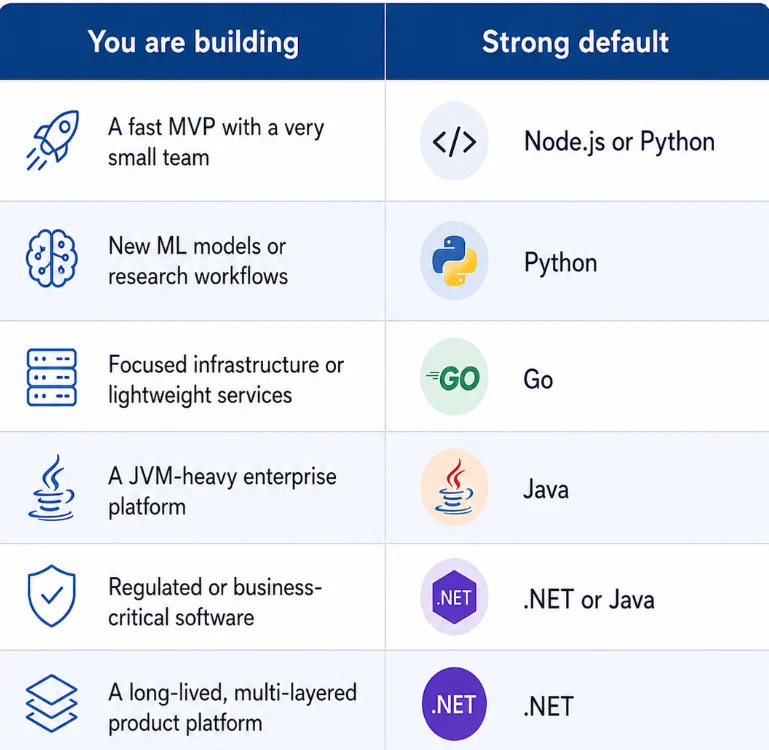
These are starting points, not universal rules.
The team’s experience, existing systems, operational environment, and product requirements matter more than benchmark headlines.
The real takeaway
.NET is not the correct stack for every application.
It does not need to be.
Its strength is that it provides supported, cohesive building blocks across a wide range of requirements: APIs, background processing, data access, authentication and authorization, observability, cloud deployment, and production AI integration.
That breadth matters when a system is expected to survive multiple product generations, team changes, and years of new requirements.
Node.js may help a web-focused team reach the market faster. Python may provide the shortest route into a particular ML library. Go may produce the simplest focused service. Java may fit an established JVM organization with the least disruption.
.NET becomes compelling when the problem is not just shipping one component.
It is keeping the entire platform understandable, maintainable, and operational five years later.
Match the tool to the challenge, not the hype cycle.