In our review work, easy-to-review pull requests tend to move faster. The engineers who sustain that flow are not necessarily the cleverest coders; they have mastered the art of making their changes understandable.
Code reviews don't have to be the bottleneck in your development process. With the right approach, they can support faster, more reliable shipping. Here's how to transform your pull requests from a necessary evil into an advantage.
The Clarity Principle
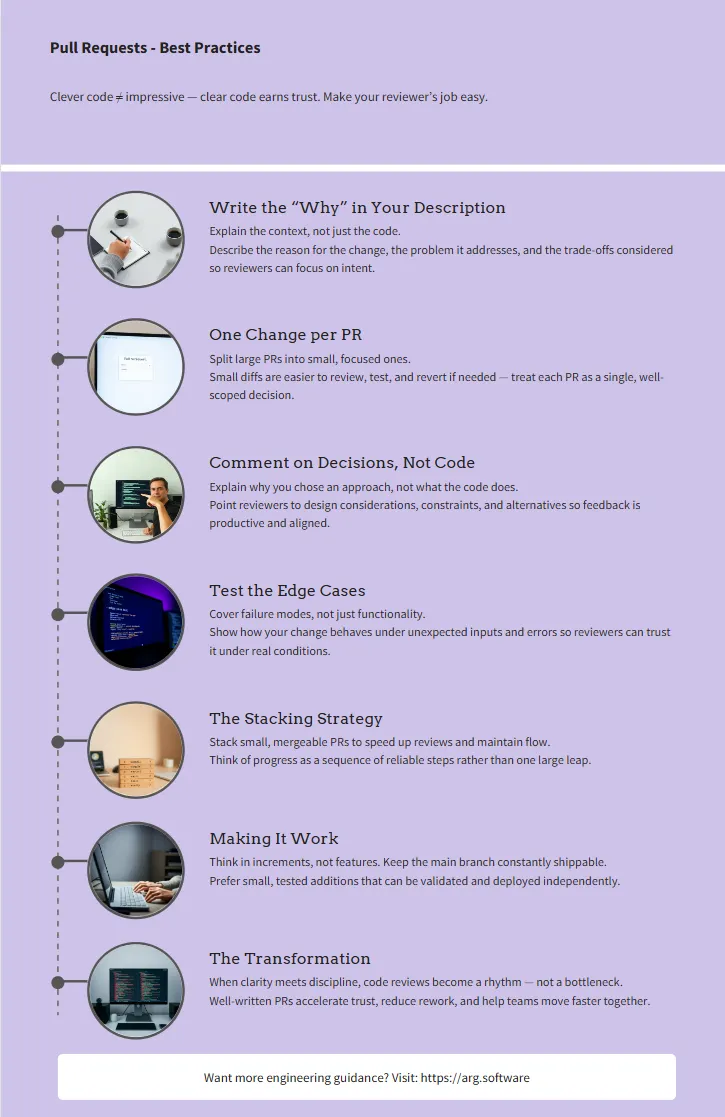
Clever code might impress your colleagues for a moment, but clear code earns their trust. When your PR gets merged quickly, deployed confidently, and maintained easily, that's when you know you've done it right.
One major part of the difference is making your reviewer's job as easy as possible.
Four Rules That Change Everything
Write the "why" in your description
Your PR description isn't documentation - it's a gift to your future teammates. What problem are you solving? Why does it matter? What alternatives did you consider?
A few minutes spent writing this context can save reviewers a longer round of detective work. More importantly, it forces you to articulate your reasoning, often revealing issues before anyone else looks at the code.
One coherent change per PR
There is an old review joke: ask someone to review 10 lines and they will find 10 issues; ask them to review 500 and they will say it looks good. It is not a measured law, but the point lands.
This is the rule many engineers break, and it can cost days of review time. When you bundle an unrelated refactoring with a feature and a bug fix, reviewers have to separate behavioral risk from cleanup before they can evaluate either.
The solution is surgical: split unrelated work. Your refactoring becomes an easier review. Your feature becomes a focused discussion. Your urgent bug fix no longer waits behind cleanup.
Explain surprising choices
Your code already shows what getUserByEmail() does. What it may not show is why you chose this approach over caching the user, why you're handling errors this way, or why this implementation is simpler than it appears.
Great PR notes, and rare code comments where the reason must travel with the code, explain context the diff cannot capture. They answer the questions reviewers will ask before they have to ask them.
Test the edge cases
Getting code to work on the happy path is not enough. Strong engineers think about failure modes: What happens when the API is down? When the list is empty? When two requests arrive simultaneously?
These edge cases aren't just about defensive coding - they demonstrate that you've thought through the system's behavior. They give reviewers confidence that your code won't wake them up at night.
The Stacking Strategy
But here's where it gets interesting. Even excellent PRs can create delays when you're waiting on reviews to continue your work. One option is to stop waiting.
Stack your pull requests.
Instead of creating one extensive PR and sitting idle while it's reviewed, open a series of small PRs, each building on the last. The first PR might refactor the data layer. The second adds the API endpoint. The third wires it to the UI.
This approach can multiply your advantages:
- You invite feedback earlier. Problems can be caught while the foundation is still small. Feedback on a base PR can also invalidate its descendants, so keep the stack short and expect some rework.
- Smaller PRs mean easier reviews. Review effort depends on complexity, not line count alone, but focused changes are easier to reason about. Google’s engineering guidance similarly recommends one self-contained change and explicitly rejects a universal line-count rule.
- You reduce scheduling dependence. Unlike pair programming, asynchronous review does not require everyone to be available at the same moment. That flexibility is useful, though it can also lengthen feedback if reviewer capacity is scarce.
The key is making each PR coherent and safe to merge in its documented order. A true stack does contain dependencies, so link the base PR, keep the chain short, and rebase or retarget it as earlier changes land. Each merge should leave the main branch buildable and operable; use backward-compatible transitions or disabled feature flags when incomplete behavior must not reach users.
Making It Work
Stacked PRs require a mental shift. You're not trying to complete a feature in one shot - you're breaking it into reviewable increments. Each PR should answer a single question or solve a single problem.
Your first PR might not look impressive. It could add characterization tests or perform a behavior-preserving refactor that makes the later change easier to see. Avoid speculative helpers with no current use. By the time you open the PR that adds the feature, reviewers understand the tested foundation.
Some teams use tools to manage stacked PRs, but you don't need them to start. You need discipline: keep PRs focused, make dependencies explicit, and always ensure the main branch stays shippable.
The Transformation
When you combine clear PRs with a careful stacking strategy, code review can stop feeling like one giant gate and become a rhythm.
Your teammates can review more readily because the work is easier to understand. You can continue with the next increment while earlier changes are reviewed. The feedback becomes more useful because reviewers can think deeply about focused changes.
And perhaps most importantly, you build trust. When your PRs are consistently clear, focused, and well-tested, reviewers spend less time reconstructing intent and more time testing assumptions. Trust should improve the conversation, not end the questioning.
The Bottom Line
Great engineering isn't about writing code that makes you look smart. It's about writing code that makes your team effective.
Every PR is an opportunity to earn trust. Choose clarity over cleverness. Choose focus over comprehensiveness. Choose rhythm over heroics.
Your code reviews can slow delivery or improve it. PR structure is one part of that outcome; reviewer capacity, ownership, risk, and team norms matter too.
Stop treating PRs as a chore. Start treating them as a tool for shipping more without hiding risk.